
Hunger
Record donations are arriving from fewer people, public food assistance is shrinking, and many everyday needs still cannot be bought with benefits. Here is what that means for goods-based giving.
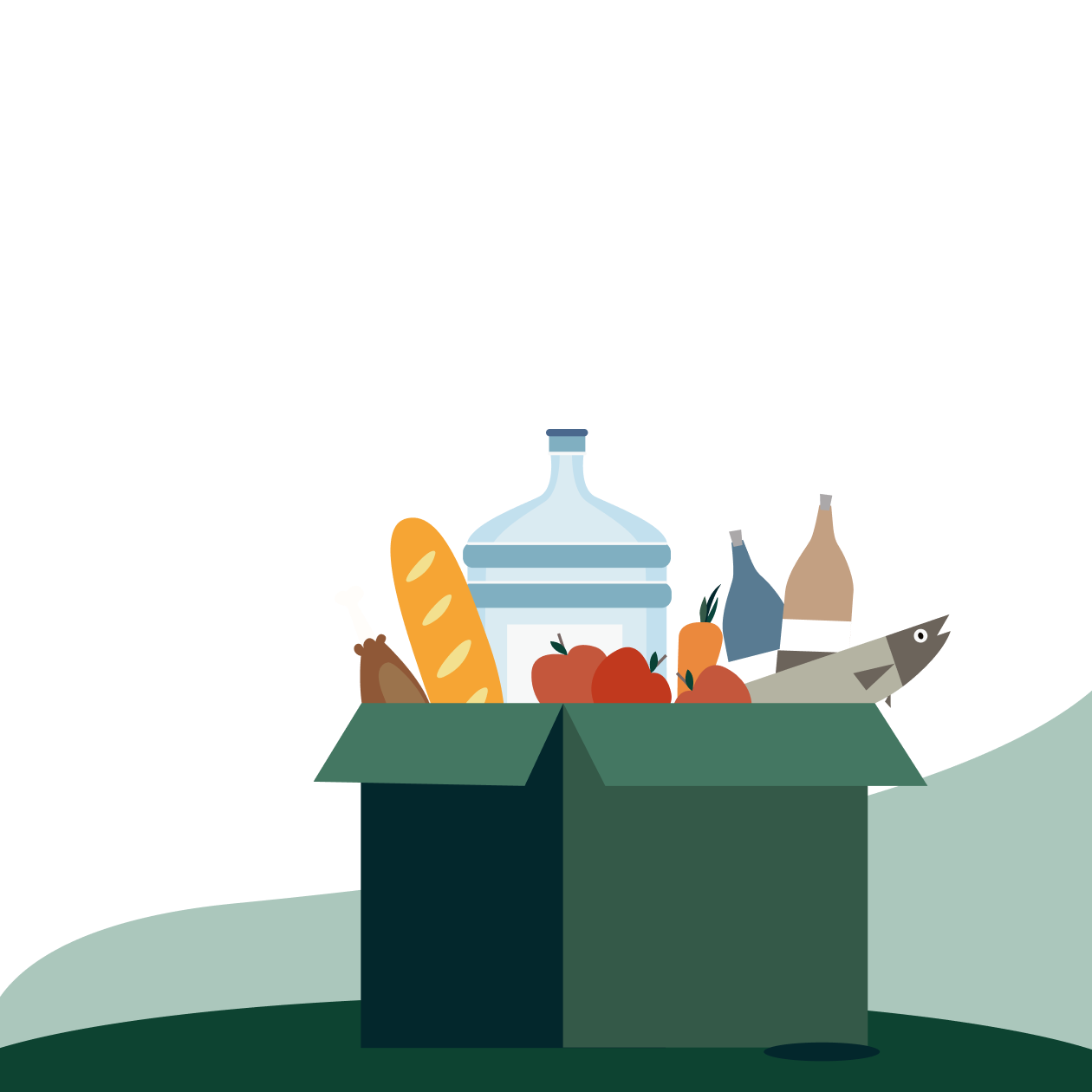
Essential goods — food, hygiene, and household supplies — are what many partner charities need most. Illustration from the Donation Supply site.
In this article
0%
Giving USA 2026 reports that total U.S. charitable giving reached $617.20 billion in 2025, up 5.7% in current dollars and the first time the total has passed $600 billion. [1] Individuals still account for most of that money, about 64%, but individual giving grew more slowly than the headline, and Giving USA notes that weak consumer sentiment may have held some households back. [1]
The more current picture is even starker. In the first half of 2026, the Fundraising Effectiveness Project found that fundraising dollars rose an estimated 6.6% while the number of donors fell 1.6%. [2] Major and supersize donors now give 76.4% of all dollars, though they make up just 2.9% of donors. [2] Micro donors — people giving $100 or less — are still more than half of all donors, and they were the only group to decline in both count and dollars. [2]
“Seventy-four percent of Americans say that seeing how a nonprofit uses its money would raise their trust in it.”
Independent Sector, Trust in Nonprofits and Philanthropy, 2026 [8]
The donors who stay are the ones who give steadily. Donors who gave seven or more times in the prior year returned at a 90% rate, compared with 14.4% of one-time donors. [2] Recurring donors are the clearest version of that habit: Neon One’s 2026 report found they were retained at about 79% in 2025, versus 32% for everyone else, and their average lifetime value was roughly twice as high. [7]
While the donor base narrows, need is growing. USDA’s final Household Food Security report found that 13.7% of U.S. households — 18.3 million — were food insecure in 2024. [12] That report will not be updated. In September 2025, USDA ended future editions, leaving the sector without its main national measure just as conditions are shifting. [13]
Benefits are shrinking at the same time. The Center on Budget and Policy Priorities, as reported by Axios, estimates SNAP participation fell by more than 4.5 million people between July 2025 and April 2026, including more than 1.5 million children. [3] Feeding America says its network faces a 30% decline in TEFAP food pounds from fiscal year 2024 to 2026. [4] Food banks are buying record amounts of food to close the gap. [3]
Some of the most basic needs are not just underfunded. They are ineligible. SNAP and WIC do not cover soap, toothpaste, diapers, menstrual products, or cleaning supplies. In Good360’s 2026 Health & Hygiene Report, 82% of partner organizations that can see what their clients experience said that gap comes up frequently or always, and about 73% named menstrual products as a critical shortfall. [14]
That is a goods problem, not only a cash problem. On GivingTuesday 2025 alone, 13.5 million Americans gave goods. [10] The same pattern is showing up close to home. Long Island pantries have reported record demand this fall, including a rising need for baby supplies and clothing. [5] Island Harvest estimates about 53,000 children on Long Island face food insecurity, up 20% from last year. [15]
A few things cut through this moment:
Donation Supply is a young 501(c)(3) with partners in New York City and on Long Island, including The Bowery Mission, QSAC, and the Wildlife Center of Long Island. The most honest thing we can say right now is also the most useful: the need around us is documented, the model is built for this moment, and the next thing we owe donors is evidence — itemized purchases, delivery dates, and confirmation from the charities that received them.
GivingTuesday is December 1, 2026. [11] Moments like that bring people in. The work is to make the second gift a monthly one, and then to show, plainly, what that gift became.
One hundred percent of monthly donations buy and deliver essential items to vetted partners. Start a recurring gift, and follow the delivery from there.
Short answers to questions people often ask about monthly giving, donated supplies, and tax deductibility.
Donation Supply is a 501(c)(3) nonprofit, and monthly donations are tax-deductible; the organization provides receipts for your records. Starting with tax year 2026, people who do not itemize can deduct up to $1,000 in qualifying cash gifts, or $2,000 for married couples filing jointly. [6] This is general information, not tax advice; a tax professional can advise on your situation.
Partner charities typically need essential physical goods such as food, hygiene products, clothing, and other everyday items that meet immediate needs. SNAP and WIC do not cover soap, toothpaste, diapers, menstrual products, or cleaning supplies, and Good360’s 2026 Health & Hygiene Report found that 82% of partner organizations that can see what their clients experience said that gap comes up frequently or always. [14] About 73% named menstrual products as a critical shortfall.
Cash is flexible, but it cannot buy what public benefits legally exclude. That goods gap is why in-kind help remains a mainstream habit: 13.5 million Americans gave goods on GivingTuesday 2025 alone. [10] A monthly gift that is used to purchase and deliver those items can fill a need a benefits card cannot.
Seventy-four percent of Americans say that seeing how a nonprofit uses its money would raise their trust in it. [8] Donation Supply’s model is to use 100% of monthly donations to buy and deliver goods to thoroughly vetted, U.S.-based charities and to report back on that delivery. Proof of what was purchased, what it cost, and where it went is part of earning that trust.
Recurring donors are far more likely to stay: Neon One’s 2026 report found they were retained at about 79% in 2025, compared with 32% for everyone else, and their average lifetime value was roughly twice as high. [7] The Fundraising Effectiveness Project also found that donors who gave seven or more times in the prior year returned at a 90% rate, versus 14.4% of one-time donors. [2] A monthly gift turns that habit into a steady supply of goods.
The IRS says the new deduction for people who do not itemize applies only to qualifying cash gifts; noncash gifts, and gifts to donor-advised funds or supporting organizations, do not count toward that $1,000 or $2,000 cap. [6] If you itemize, different charitable-deduction rules may apply. This is general information, not tax advice.
This post is for general information. It is not tax or legal advice. Statistics are drawn from the published sources listed above. Donation Supply Inc. is a New York 501(c)(3) nonprofit (EIN 87-2449873). No Donation Supply impact figures are cited because none have been published yet.
Join our monthly giving community and get updates on the goods we buy and deliver to vetted partners. A newsletter form can be connected later; for now, start a monthly gift.
